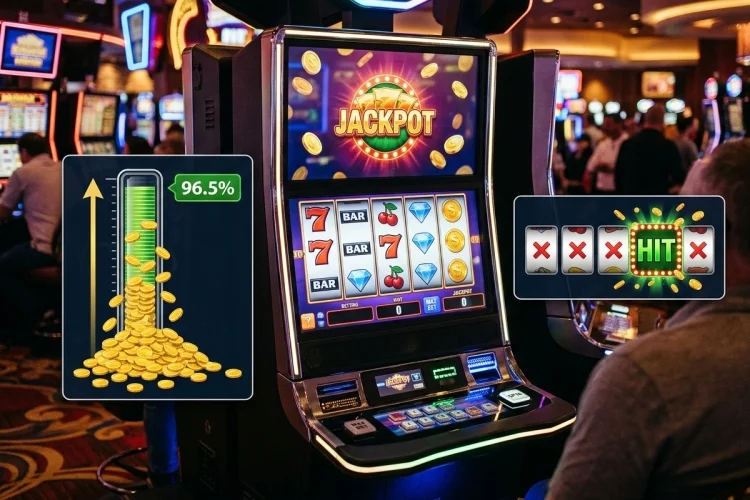
You open the same online slot at two casinos and everything looks identical. The graphics match, the bonus feature works the same way, and even the paytable appears familiar.
Then you check the game information and notice something strange: one version shows 96% RTP while the other displays 94%. That difference is possible because many modern providers release several mathematical configurations of the same title.
Understanding Why Slot RTP Can Vary Between Casinos helps explain what those percentages actually represent and why checking the game information can matter more than relying on a review.
RTP Is a Long-Term Mathematical Percentage
RTP stands for return to player. It represents the theoretical percentage of total wagers that a game is designed to return across a very large number of rounds.
A 96% RTP does not mean that depositing $100 should leave you with $96. Short sessions can finish far above or below the theoretical percentage because normal volatility creates significant variation.
The UK Gambling Commission describes RTP as a long-term theoretical average rather than a reliable prediction of what one individual will receive during a particular session.
That distinction is important before comparing two RTP settings. The percentage describes the game’s mathematics over extensive play, not a guaranteed personal result.
Providers Can Release Several RTP Versions
One of the biggest reasons for RTP differences is surprisingly simple: the developer may have created multiple versions.
Hacksaw Gaming’s Wanted Dead or a Wild, for example, is officially listed with RTP options of 96.38%, 94.55%, 92.33%, and 88.42%. The visual design and central features remain recognisable, but the mathematical return can differ depending on which configuration is being supplied.
Quickspin does something similar. Cash Truck 2 is offered in 96%, 94%, 92%, and 87% versions, with the provider describing these configurations as a way to serve different markets and commercial requirements.
So the percentage is not always one permanent number attached to a slot title.
Casinos May Select Different Available Configurations
A provider creates the available mathematical models, while operators may offer a particular approved version depending on their market, platform arrangement, and commercial setup.
Push Gaming makes this especially clear on the official Jammin’ Jars page. The title currently lists 96.83% and 94.25% RTP versions and states that RTP may vary by casino. It also tells players that the active percentage can be found in the user panel and game loading screen.
That means seeing Jammin’ Jars at two casinos does not automatically prove both are offering the 96.83% version.
The interface may look almost exactly the same, making the difference easy to miss unless you actually check the game information.
Lower RTP Usually Changes the Math, Not the Artwork
When people hear that RTP varies, they sometimes imagine a casino employee moving a percentage slider while someone is playing.
That is not a good way to picture it.
Provider documentation shows that RTP variants can be built as seperate game configurations. Quickspin’s Reel Nightmare game sheet, for example, lists different game IDs for its 96%, 94%, 92%, and 87% versions. The underlying RTP distribution also changes between those configurations.
The player may barely notice a visual difference because the title, artwork, wild mechanics, and bonus presentation can remain familiar.
The mathematical model underneath is where the variation occurs.
Why Would a Casino Use a Lower RTP Version?
Commercial margins are one reason providers make multiple versions available.
A simple theoretical example shows the difference. Across $100,000 in total wagers, a 96% game mathematically allocates around $96,000 toward player returns over the long run, while a 92% model allocates around $92,000.
That does not mean a particular casino will literally earn the remaining amount over a short period. Variance means actual performance can move substantially around the theoretical figure.
Still, the percentage difference affects the game’s expected long-term economics. Quickspin openly describes multiple RTP configurations as supporting wider market reach and different margin requirements.
Different regulatory environments and commercial agreements can therefore contribute to the version players eventually see.
A Small RTP Difference Adds Up Theoretically
The gap between 96% and 94% may look tiny because it is only two percentage points.
Over large wagering volumes, however, the theoretical difference becomes more meaningful.
Imagine that total cumulative wagering reaches $10,000 over time. At a purely mathematical level, 96% RTP corresponds to $9,600 in theoretical return, while 94% corresponds to $9,400.
Again, this is not a prediction of an individual’s final balance. Someone could experience a major bonus early, while another player could lose quickly.
RTP becomes meaningful statistically across enormous samples, which is precisely why short demo sessions are a poor way to estimate it.
RTP and Volatility Are Not the Same Thing
Another common mistake is treating RTP as a measure of how often you win.
It is not.
Volatility describes how payouts are distributed. High-volatility games can concentrate more of their theoretical return into less frequent, potentially larger results, while lower-volatility titles generally distribute outcomes more evenly.
Two slots could both have 96% RTP yet feel completely diferent during 100 spins.
Similarly, a 94% version does not necessarily mean you will notice exactly 2% fewer winning spins than with a 96% model. The difference might instead appear through bonus frequency, prize distribution, feature returns, or another part of the mathematical structure.
Regulators Can Require RTP Information to Be Available
Transparency matters because players cannot identify a game’s mathematical configuration from its artwork.
Under UK Gambling Commission remote technical standards, customers must be given information about how games work and either RTP, house edge, or relevant probabilities before committing to gamble.
The Commission also requires operators to monitor actual RTP against the expected advertised RTP so unusual underpayments or overpayments can be detected.
These requirements highlight why the figure inside the actual game is more useful than an RTP copied from an old review.
Always Check the Game Information Screen
If you want to know which version you are actually playing, open the help, information, paytable, or settings panel.
Push Gaming specifically notes that its active RTP can be displayed in the user panel and loading screen for games where configurations vary.
Do not assume a search result saying “96% RTP” automatically applies everywhere.
Reviews can become outdated, regional versions can differ, and the writer may have tested another configuration.
Checking the active game takes only a few seconds and provides a much more acurate answer.
Understanding Why Slot RTP Can Vary Between Casinos comes down largely to multiple mathematical configurations. Providers can offer the same game at several RTP levels, and casinos may carry different approved versions.
Before playing, open the game information panel and verify the percentage yourself. Treat RTP as a long-term statistic, compare it alongside volatility and features, and never expect it to predict one individual session.